


ANDREW PLIMER
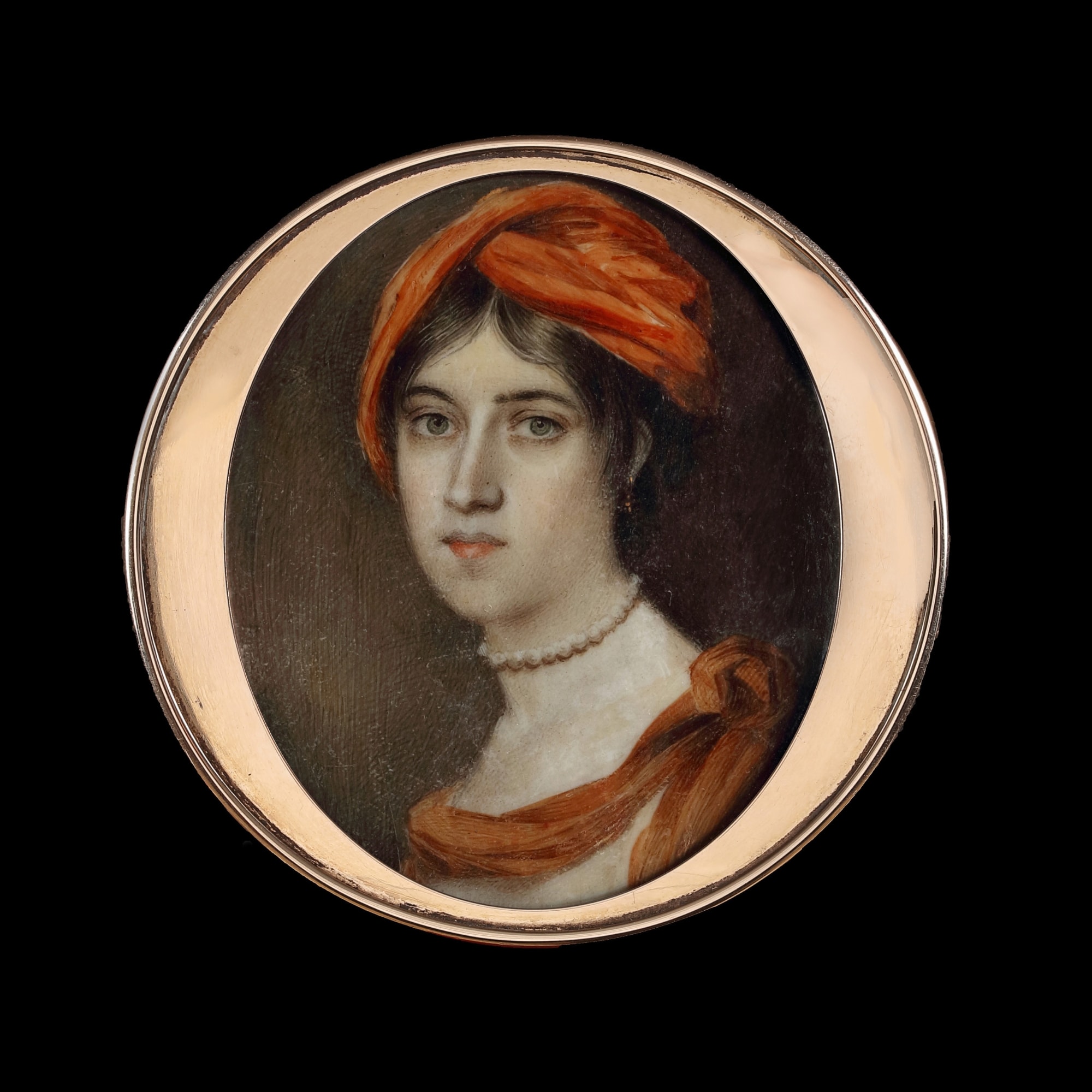
Portrait miniature of a Lady, wearing a rust-coloured turban and matching shawl, a pearl choker and a white dress
Marketplace
Portrait miniature of a Lady, wearing a rust-coloured turban and matching shawl, a pearl choker and a white dress
ANDREW PLIMER
Portrait miniature of a Lady, wearing a rust-coloured turban and matching shawl, a pearl choker and a white dress
The Limner Company : Portrait Miniature
Date circa 1800
Period Georgian
Origin England
Medium Watercolour on ivory, Tortoiseshell
Dimension 6.7 cm (2⁵/₈ inches)
This portrait miniature of a hazel-eyed young lady shows the influence of geopolitics on fashion at the turn of the 18th-century. What’s more, the garments worn arguably lay bare the empirical ambitions of one man, Napoleon Bonaparte (1769-1821)
Just visible at the bottom of the picture is the lady’s white dress, which would have had a high waist, just under the bust. This distinctive shape, which was later (in the 20th century) dubbed the ‘Empire line/silhouette/waist’, were de rigeur by the time Napoleon declared the first French empire in 1804. These diaphanous white gowns were inspired by antique Greco-Roman styles, recently unearthed in Italy, now under Napoleon’s control. The look was popularised by Napoleon’s wife at the time, Empress Joséphine (previously de Beauharnais; 1763-1814), Queen of Italy (1805-1810).
The sitter also wears a turban-style headdress, a fashion owed to Napoleon’s occupation of Ottoman-held Egypt and Syria (1798-1801). Such headwear became particularly popular for evening wear, and it may be that this lady, with her matching shawl and pearl choker necklace, is in evening dress.
By the time this miniature was painted, the artist Andrew Plimer was a successful professional artist working in London’s fashionable Soho. From a studio as 8 Golden Square[1], Plimer must have been one of the busiest miniaturists in London as his surviving oeuvre is vast.
The artist would also marry in 1801, and his wedding was attended by two highly esteemed miniaturists of the elder generation: Jeremiah Meyer R. A. (1735-1789) and Plimer’s mentor Richard Cosway R. A. (1742-1821).
[1] Plimer lived at 3 Golden Square 1786 before moving to 8 Golden Square in 1796.
Just visible at the bottom of the picture is the lady’s white dress, which would have had a high waist, just under the bust. This distinctive shape, which was later (in the 20th century) dubbed the ‘Empire line/silhouette/waist’, were de rigeur by the time Napoleon declared the first French empire in 1804. These diaphanous white gowns were inspired by antique Greco-Roman styles, recently unearthed in Italy, now under Napoleon’s control. The look was popularised by Napoleon’s wife at the time, Empress Joséphine (previously de Beauharnais; 1763-1814), Queen of Italy (1805-1810).
The sitter also wears a turban-style headdress, a fashion owed to Napoleon’s occupation of Ottoman-held Egypt and Syria (1798-1801). Such headwear became particularly popular for evening wear, and it may be that this lady, with her matching shawl and pearl choker necklace, is in evening dress.
By the time this miniature was painted, the artist Andrew Plimer was a successful professional artist working in London’s fashionable Soho. From a studio as 8 Golden Square[1], Plimer must have been one of the busiest miniaturists in London as his surviving oeuvre is vast.
The artist would also marry in 1801, and his wedding was attended by two highly esteemed miniaturists of the elder generation: Jeremiah Meyer R. A. (1735-1789) and Plimer’s mentor Richard Cosway R. A. (1742-1821).
[1] Plimer lived at 3 Golden Square 1786 before moving to 8 Golden Square in 1796.
Date: circa 1800
Period: Georgian
Origin: England
Medium: Watercolour on ivory, Tortoiseshell
Dimension: 6.7 cm (2⁵/₈ inches)
Provenance: Private collection, UK.
Discover the Gallery

The Limner Company : Portrait Miniature
Potrait miniatures from the 16/17th century, the 18th century and 19th century
More artworks from the Gallery
-Portrait miniature of a Field Officer wearing the undress uniform of a Royal regiment_T639256182791544484.jpg?width=500&height=500&mode=pad&scale=both&qlt=90&format=jpg)
-Portrait miniature of Abelard and Heloise he in black doublet and white ruff, she in white gown and veil, a red cl_T639180852454042567.JPG?width=500&height=500&mode=pad&scale=both&qlt=90&format=jpg)


, wearing blue coat, white waistcoat, and frilled white collar_T639131491024376186.JPG?width=500&height=500&mode=pad&scale=both&qlt=90&format=jpg)
