
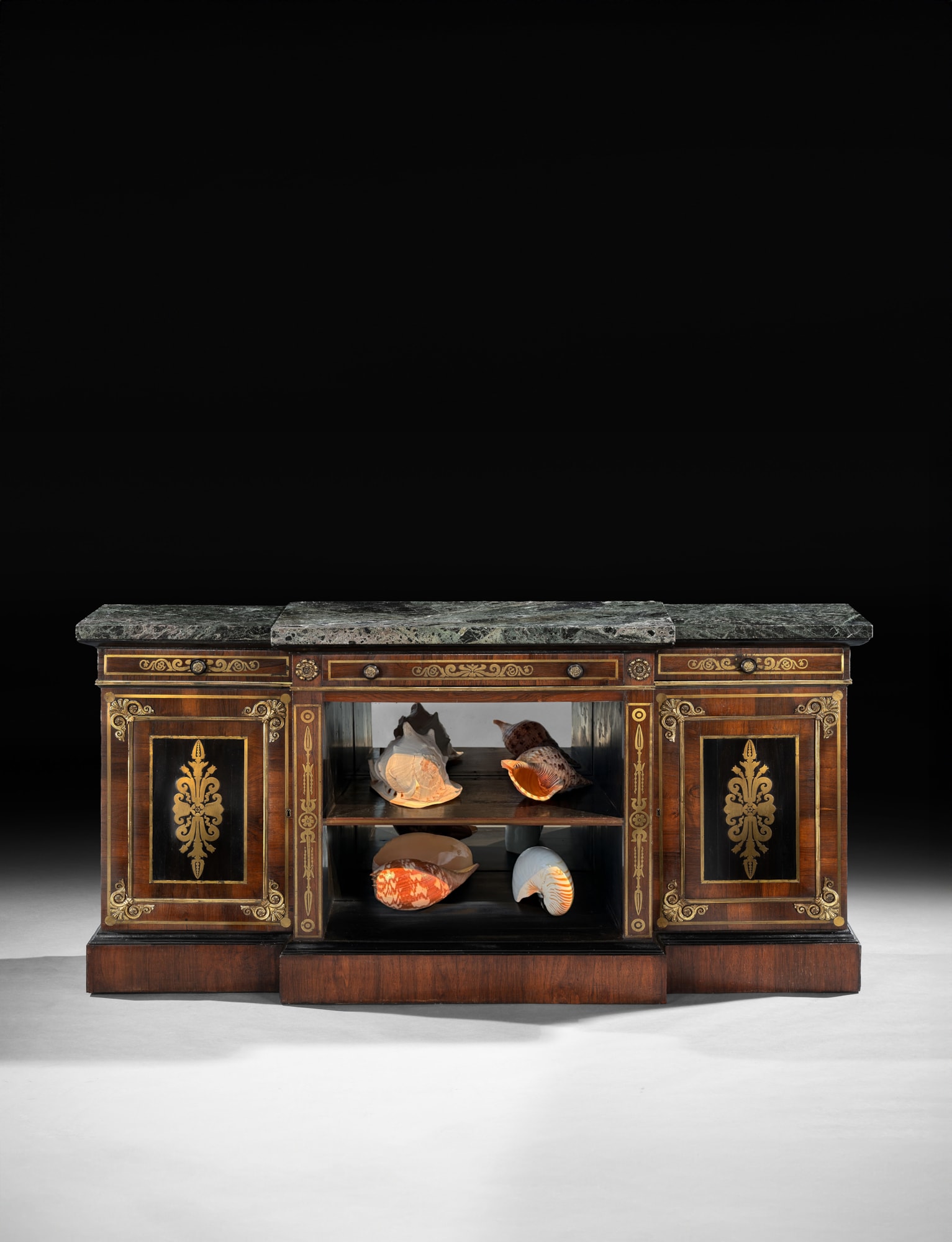
A REGENCY ROSEWOOD AND BRASS INLAID SIDE CABINET, Attributed to George Bullock
Marketplace
A REGENCY ROSEWOOD AND BRASS INLAID SIDE CABINET, Attributed to George Bullock
A REGENCY ROSEWOOD AND BRASS INLAID SIDE CABINET, Attributed to George Bullock
George Bullock was one of the most innovative English cabinet makers of the Regency period. Born in Birmingham, he began his career as a sculptor and wax modeller before establishing a furniture business in Liverpool in the early nineteenth century. His talents as a designer, craftsman, and entrepreneur soon earned him a reputation for producing furniture of exceptional quality and originality. Bullock’s work was strongly influenced by classical Greek and Roman art, as well as the fashionable French Empire style. However, unlike many of his contemporaries, he often used native British materials such as oak, yew, holly, larch, and laburnum rather than imported exotic woods. His furniture was distinguished by elegant forms, fine marquetry, brass inlays, and decorative motifs based on British plants and flowers.
In 1812, Bullock moved to London, where he attracted wealthy and influential clients. He displayed his wares for a while in a Grecian gallery of his own design in the Egyptian Hall on Piccadilly in the heart of London, a venue for art and entertainment set up and run by his brother, William. Among his notable commissions were furnishings for Sir Walter Scott and furniture intended for Napoleon Bonaparte’s residence on the island of St Helena. His cabinets, tables, and bookcases combined practicality with artistic beauty and are now regarded as masterpieces of British Regency furniture. Although Bullock died suddenly in his thirties in 1818, his contribution to furniture design was significant. An anonymous obituarist in a magazine of the time, praised him as one 'who carried taste, in design of furniture, to a higher pitch than it was ever carried before in this country'.Today, historians and collectors admire his creativity, craftsmanship and distinctive use of British materials. His work remains an important part of the history of English decorative arts and cabinet making.
In 1812, Bullock moved to London, where he attracted wealthy and influential clients. He displayed his wares for a while in a Grecian gallery of his own design in the Egyptian Hall on Piccadilly in the heart of London, a venue for art and entertainment set up and run by his brother, William. Among his notable commissions were furnishings for Sir Walter Scott and furniture intended for Napoleon Bonaparte’s residence on the island of St Helena. His cabinets, tables, and bookcases combined practicality with artistic beauty and are now regarded as masterpieces of British Regency furniture. Although Bullock died suddenly in his thirties in 1818, his contribution to furniture design was significant. An anonymous obituarist in a magazine of the time, praised him as one 'who carried taste, in design of furniture, to a higher pitch than it was ever carried before in this country'.Today, historians and collectors admire his creativity, craftsmanship and distinctive use of British materials. His work remains an important part of the history of English decorative arts and cabinet making.
Discover the Gallery

Godson & Coles
English Antique Furniture and Modern British Art
More artworks from the Gallery