


Osias Beert
A still life from the collection of King Charles I of England
Osias Beert
A still life from the collection of King Charles I of England
Date 1610 or earlier
Origine Flanders, Antwerp
Medium Oil on panel
Dimension 57 x 15 cm (22¹/₂ x 5⁷/₈ inches)
Fred G. Meijer
Art historian
Dutch and Flemish seventeenth-century painting
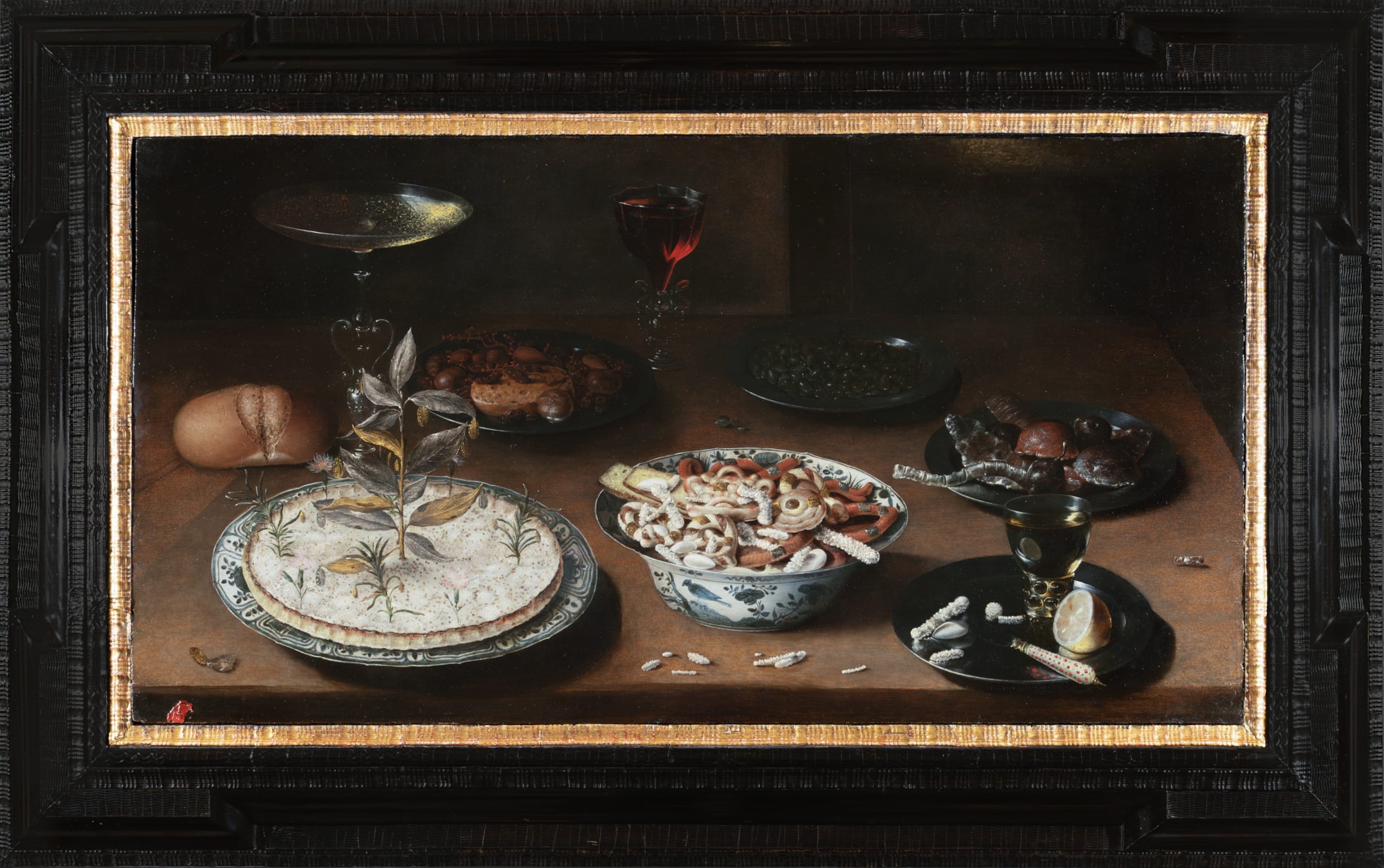
A still life on a wooden table: up front are, from left to right, a plate of Chinese Wanli porcelain carrying a flat, sugared tart, adorned with sprigs of rosemary, two carnations, and a branch with gold- and silver-painted leaves in the centre; a Wanli porcelain bowl of sweetmeats, and a pewter dish carrying a knife, a rummer of white wine, sugared confectionery, and half a lemon. Behind, from left to right, are a bread roll, an elaborate glass tazza of white wine, a pewter dish with nuts, currants and a slice of bread, an Venetian-style glass of red wine, a pewter dish of capers and a pewter dish of candied fruit. The branches and sprigs on the tart are adorned with glass and metal ornaments, one of which, attached to half a leaf, lies to the left. Spread across the table, particularly at front centre, are various sweets. The right edge of the table, which is in part placed against a wall, is partly visible.
The Author
Osias Beert was probably born in Antwerp, in or around 1580. In 1596, he was registered by the Antwerp painters’ guild as a pupil of Andries van Baesrode (1574-1641), and enrolled as a master in 1602. He married Margarita Ykens (died 1646/47) on 8 January 1606. Their son Osias Beert the Younger (1622-c.1678) also became a painter, but no work can be attributed to him with any certainty[1]. While registered as a painter, Osias Beert was also recorded as a cork tradesman. He trained several pupils, but it appears that only one of them, his cousin Frans Ykens (1601-1692/93), became a still-life painter, like his teacher.
Osias Beert was one of the pioneers of still-life painting in Antwerp and a highly esteemed artist, of which recognition numerous (more or less) contemporary copies and imitations of his work bear witness. Today, barely a dozen signed or monogrammed still lifes by Beert are known. Not one of those is dated, but as many as four of his still lifes were painted on copper plates dated by their maker, Peeter Stas (c.1565-1617 or later) to 1607, 1608, and 1609, providing at least an indication of the year in which they were been painted. The presently known surviving total of works considered to be by Beert with certainty does not appear to outnumber fifty.
About half of the known oeuvre of this contemporary of Jan Brueghel the Elder (1568-1625) and Ambrosius Bosschaert the Elder (1573-1621) consists of flower pieces and still lifes including bouquets; the other half are still lifes displaying fruit, oysters and other victuals, often in rather costly containers. Osias Beert died in Antwerp in late 1623.
In Beert's palette, earth colours are often predominant, balanced by cool blues and greys and strengthened by red, yellow, and bright green accents. His flower pieces, by the nature of their subject, show more variegation. In many areas, Beert accomplished the brightness and subtle detail in his works by the use of glazes on a light ground, while details were often rendered with fine linear accents. In larger works, there are usually also elements that have been handled somewhat more painterly, particularly items in the background.
Beert’s early works, from the years before c.1610, are his most refined pieces. While quite a few of Beert's works have lost their original appearance due to loss of topmost layers of glaze, in the still life discussed here, the original paint layers are generally well preserved, which allows the viewer to study Beert's handling closely[2].
This unpublished still life is a most important addition to the oeuvre of Osias Beert. It fits seamlessly in the group of early works from before c.1610, for some of which a date can be established with the help of the date stamped into the reverse of the copper plate on which they were painted, as mentioned above. Moreover, the brand of Henry Prince of Wales on the back of the panel provides a date ante quem. Henry died in 1612, aged 18, so the painting must have entered into his collection in or – presumably – not long before that year (fig. 1). Subsequently it came to his brother, Charles I and received his brand as well.
The pewter plate with a knife and rummer at lower right, handled quite similarly, appears in a still life on a copper panel dated 1607 by Pieter Stas, which thus must have been painted in that year of shortly after. The same glass tazza appears in two early, be it undated, examples.[3] In the first, it is shown together with very similar porcelain bowls filled with sweetmeats, in the second, a bread roll very similar to the one in the present painting is placed next to it. Such refined Venetian-style wine glasses – the tazza and the glass of red wine – represent a distinct degree of luxury. They were most likely the products of one of the glass studios led by Venetian immigrants in Liège and Antwerp, rather than an actual import from Venice. Such glasses often recur in Beert’s still lifes.
In a vertical still life on a marked and dated copper plate from 1609, Osias Beert painted a dish of nuts, currants and a slice of bread, much like the one depicted in the painting under discussion here . A dish of candied fruit like the one presented here to the right can be found in a small still life that likely originated around the same time .
As in most of his still lifes of this type, Beert arranged his objects and victuals on a plain wooden table. Mostly, the sides of the table are not visible, but in the present painting part of the right-hand side can be seen. It would also appear that the artist has extended the left side of the table, so he could position the bread roll there.
Dishes of Chinese Wanli porcelain are a recurring feature in Beert's still lifes of this type. Such porcelain was imported by the East-India trade companies and got its popular name of Kraak porcelain – a term still internationally used today – from early examples that were taken from a captured Portugese merchant vessel, of a type that was called ‘cararcas’. At the time when this still life was painted, such dishes were still very costly rarities. For this painting, it would seem that Beert had no example of the type of bowl at hand and was probably working at random: the artist has clearly portrayed a bowl of the so-called klapmuts type (Dutch for brimmed hat), and quite accurately so, but the decoration he depicted on the side was more likely on the inside of the bowl, normally the side shows a repeating geometrical pattern. The locally made pewter dishes were common household objects and they feature in many of Beert’s still lifes, as well as in the work of many other artists throughout the seventeenth century.
The sugared tart to the left is unique in Beert’s oeuvre. A similar piece of pastry, however, appears in a still life by Clara Peeters (?c.1589-1636 or later?), probably from the 1610s, in a private collectionIt has been suggested that the tart was part of a wedding banquet.[4] Peeters’ earliest known still life, from 1607, features a similarly adorned sprig of rosemary. That painting may have originated around the time of her own wedding.[5]
Negotiations for a wedding between Henry, Prince of Wales, and Catarina de’ Medici or Christine, daughter of Henri IV of France were in progress, but Henry died before an actual marriage could be arranged. Whether this panel was a proper acquisition, or a gift, perhaps from one of the suiting parties, must remain the subject of speculation.
[1] The assumption that he worked in the style of his father is probably unfounded. The elder Beert died when his son was only about one year old, so he cannot have trained him. By the time Osias Beert II became a master in 1644, his father’s style was already considered archaic. A still life with oysters and a herring, reportedly signed and dated 'Osias ... 1650', was auctioned at Christie's London on 12 October 1956, but no photograph of it appears to exist.
[2] However, the blue decorations of the porcelain plate and bowl appear to have been painted with smalt, which tends to fade from a strong blue to grey, so the blue will have been brighter.
[3] The first looks somewhat grey in tone, but the table cloth was probably panted with red lake (on top of a grey ground) which has almost entirely faded, so it must have had a more colourful appearance, certainly when we take into account that the decorations on the porcelain, here too, were probably painted with smalt.
[4] See exhibition catalogue The Art of Clara Peeters, Antwerp/Madrid, 2016, cat. no. 3, pp. 76-78, colour ill.
[5] For that painting, see online database RKDimages lite, record no. 85056. Clara Peeters’ proper identity is still uncertain, but recent research has suggested that she was Clara Lamberts who married the painter Henrick Peeters in 1607.
Date: 1610 or earlier
Origine: Flanders, Antwerp
Medium: Oil on panel
Dimension: 57 x 15 cm (22¹/₂ x 5⁷/₈ inches)
Provenance:

São Roque
Fine Furniture, Silver, Portuguese Tiles and Ceramics, Arts of the Portuguese Expansion, Chinese Porcelain, Fine Arts
Plus d'œuvres d'art de la Galerie


