


-A Lover’s Eye miniature, with blue iris_T639180815897423314.JPG?width=2000&height=2000&mode=max&scale=both&qlt=90)
ENGLISH SCHOOL (19th century)
A Lover’s Eye miniature, with blue iris
Marketplace
A Lover’s Eye miniature, with blue iris
ENGLISH SCHOOL (19th century)
A Lover’s Eye miniature, with blue iris
The Limner Company : Portrait Miniature
Date circa 1815
Epoque Georgian
Origine England
Medium Watercolour on ivory
Dimension 2 cm (0³/₄ inches)
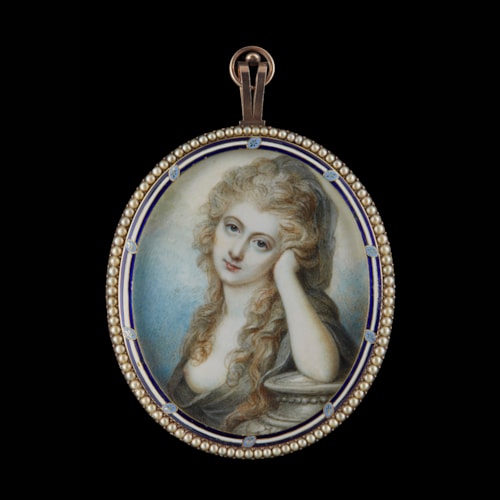
Set into the original heart-shaped locket there can be no doubting that this eye was intended for a loved one, or lover. A popular shape for eye miniatures, the teardrop shape repeats the tears shed when apart and adds a layer of sentimentality to these rare, singular ‘portraits’. While it is difficult to attribute an artist to the present eye, it is clear from fee books that British artists were undertaking commissions from the early 1770s.[1] Eye miniatures are notoriously difficult to date, despite their short-lived appearance in art and this example can only be dated from the heart-shaped locket set with seed pearls.
Eye miniatures were often at the centre of the great romances and affairs of the 18th and early 19th century. The ability to ‘hide in plain sight’ the identity of your loved one must have had great appeal in an age where double-standards were par for the course and marriages were built on money and status, not love. Eyes became the most intimate type of miniature – their identity known only to the wearer – set into brooches as with this example here. When an eye is separated from the rest of the face it becomes very difficult to ascertain the owner, and thus began a guessing game of wearing eyes – the identity known only to the wearer. These eyes are now known as ‘lover’s eyes’ – symbolising the secret nature of the most intimate of gifts.
The eye of Emma, Lady Hamilton (1765-1815), for example, was apparently presented to Lord Nelson (1758-1805) as he left for the Battle of Trafalgar.[2] When George, Prince of Wales, sent Maria Fitzherbert (1756-1837) his eye miniature, he wrote ‘I send you a Parcel. . . and I send you at the same time an Eye, if you have not totally forgotten the whole countenance. I think the likeness will strike you’, he began a fad for eye miniatures which quickly caught on in his circle of friends.
As Elle Shushan points out, eyes miniatures are difficult to categorise in art – they are a ‘hybrid, part portrait, part jewellery, part decoration’.[3] It is with extreme fascination that they are regarded today – still a mystery to untangle of a love story of the past.
[3] Shushan Op. Cit., p. 27.
[1] 48 See Elle Shushan’s chapter in ‘The Look of Love; Eye miniatures from the Skier Collection, 2012, Birmingham Museum of Art, p. 19, where she cites Ozias Humphry’s feebook of 1773 painting two eye miniatures for his patron the Duke of Dorset at Knole.
[2] Sold Bonhams, London, 5 July 2005, lot 145.
Eye miniatures were often at the centre of the great romances and affairs of the 18th and early 19th century. The ability to ‘hide in plain sight’ the identity of your loved one must have had great appeal in an age where double-standards were par for the course and marriages were built on money and status, not love. Eyes became the most intimate type of miniature – their identity known only to the wearer – set into brooches as with this example here. When an eye is separated from the rest of the face it becomes very difficult to ascertain the owner, and thus began a guessing game of wearing eyes – the identity known only to the wearer. These eyes are now known as ‘lover’s eyes’ – symbolising the secret nature of the most intimate of gifts.
The eye of Emma, Lady Hamilton (1765-1815), for example, was apparently presented to Lord Nelson (1758-1805) as he left for the Battle of Trafalgar.[2] When George, Prince of Wales, sent Maria Fitzherbert (1756-1837) his eye miniature, he wrote ‘I send you a Parcel. . . and I send you at the same time an Eye, if you have not totally forgotten the whole countenance. I think the likeness will strike you’, he began a fad for eye miniatures which quickly caught on in his circle of friends.
As Elle Shushan points out, eyes miniatures are difficult to categorise in art – they are a ‘hybrid, part portrait, part jewellery, part decoration’.[3] It is with extreme fascination that they are regarded today – still a mystery to untangle of a love story of the past.
[3] Shushan Op. Cit., p. 27.
[1] 48 See Elle Shushan’s chapter in ‘The Look of Love; Eye miniatures from the Skier Collection, 2012, Birmingham Museum of Art, p. 19, where she cites Ozias Humphry’s feebook of 1773 painting two eye miniatures for his patron the Duke of Dorset at Knole.
[2] Sold Bonhams, London, 5 July 2005, lot 145.
Date: circa 1815
Epoque: Georgian
Origine: England
Medium: Watercolour on ivory
Dimension: 2 cm (0³/₄ inches)
Provenance: Private collection, UK.
Découvrez la galerie

The Limner Company : Portrait Miniature
Potrait miniatures from the 16/17th century, the 18th century and 19th century
Plus d'œuvres d'art de la Galerie
 Way (1746-1825), in a pearl-bordered cream silk dress with a fur-bordered pink surc_T639131456736962332.JPG?width=500&height=500&mode=pad&scale=both&qlt=90&format=jpg)
-Portrait of a Noblewoman, probably Maria Luisa Gabriella of Savoy (1688-1714), wearing a red dress with gold, lace-_T639180845847062533.JPG?width=500&height=500&mode=pad&scale=both&qlt=90&format=jpg)

, in profile, wearing ‘Van Dyck’ dress_T639131414228532841.jpg?width=500&height=500&mode=pad&scale=both&qlt=90&format=jpg)
, wearing Windsor uniform (blue with red collar), white_T639131521011864771.JPG?width=500&height=500&mode=pad&scale=both&qlt=90&format=jpg)