

Giovanni Domenico TIEPOLO
Christ Sent by Pilate to Herod
Giovanni Domenico TIEPOLO
Christ Sent by Pilate to Herod
While it has been proposed that these drawings may have been intended as book illustrations, the fact that many of the compositions are signed in full would suggest instead that they were always regarded by the artist as independent, finished works. Byam Shaw notes that, ‘They are essentially 'album drawings', intended not as studies for painting or etching, but as works of art in their own right; and they belong to a period when drawing, rather than painting, was Domenico’s chief occupation.’
Usually set in elaborate interior or landscape settings, the drawings of the ‘Large Biblical Series’ are among Domenico’s masterpieces as a draughtsman, executed with an assurance of handling and a fluidity of tonal washes that is often quite breathtaking. As George Knox has written, ‘[Domenico Tiepolo’s] most extensive and perhaps his most remarkable work as a draughtsman...The Large Biblical Series is a summation in more ways than one. For the first time, Domenico draws on the full resources of the Tiepolo studio, his own visual memory, his folios of drawings, and the vast accumulation of drawings by his father...Even so, by far the greater part of these compositions are entirely original inventions.’ It is likely that the artist kept the drawings in his studio until his death, as no prints were made of them.
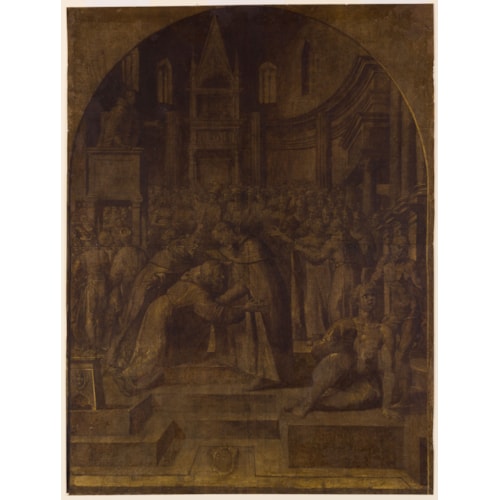
The present sheet depicts an episode that is only found in the gospel of Saint Luke, in which Pilate decides that, since Jesus is from Galilee, he should be tried by Herod: ‘When Pilate heard of Galilee, he asked whether the man were a Galilaean. And as soon as he knew that he belonged unto Herod’s jurisdiction, he sent him to Herod, who himself also was at Jerusalem at that time.’ As Adelheid Gealt and George Knox have described the present sheet, ‘Surrounded by a battalion of heavily armed soldiers, Jesus, his arms still bound, is being led from one judge to another. All eyes, including those of the patriarchal elders who stand by stage right, are fixed on him. Keeping [Saint] Peter in the drama, Domenico (maintaining his emphasis on the first Pope) elects to show Jesus staring across the crowd at Peter, who peers anxiously back at him from the far left. It should be noted that both Matthew (26:57) and Mark (14:54) mentioned that Peter followed him from “far off” to the palace of the High Priest, and there he later denied Jesus. Here again a lamp hangs suspended over Christ’s head, reminding us once more of John 8:12: “I am the light of the world.”…Jesus is led away by a large military escort from an imposing hall of justice, glimpsed on the right…The setting has the character of a scena per angolo, with two coulisses receding on either side, though not very clearly constructed, and a grand staircase rising up on the right side…This is apparently a very late and rather confused design, although the main array of figures, mostly soldiers, moves quite evenly across the scene from right to left.’
Sometime in the first decades of the 19th century the drawings of the ‘Large Biblical Series’ seem to have been divided into two main groups, both of which found their way into French collections. A group of 138 drawings were acquired in 1833 from a shop in the Piazza San Marco in Venice by the French collector Jean Fayet Durand (1806-1889) and were bequeathed to the Louvre at his death in 1889, bound in an album now known as the Recueil Fayet. A further large group of drawings from the series, amounting to around 175 sheets, was purchased in Italy, also in the middle of the 19th century, by Victor Luzarche (1803-1869), at one time the mayor of the city of Tours, and these later entered the collection of Camille Rogier (1805-1893), who had lived in Venice for several years and was a friend of both Fayet and Luzarche. Eighty-two of the ex-Luzarche drawings passed to Roger Cormier (dates unknown), also of Tours. These were dispersed at auction at in Paris in 1921, for a total of 57,850 francs, with the drawings acquired by various private collectors, notably the Duc de Trévise.
In his pioneering book on the drawings of Domenico Tiepolo, published in 1962, James Byam Shaw opined that, ‘it is with the pen and brush, in the second half of his career, that Domenico develops his most characteristic style. It is then that his compositions – in the large Biblical series particularly – become much more pictorial than his father’s, for all the freedom and looseness of his pen work; and it is his peculiar use of the wash, brown or grey or both combined, which contributes most to this effect. These were album-drawings, finished to a margin-line, such as his father seldom produced...Such drawings were intended no doubt for the collector’s portfolio, but many others he kept for his own use.’
Provenance: Among the contents of the artist’s studio in Venice at the time of his death, and by descent to his wife, Margherita Moscheni, Venice
Dispersed on the Venetian art market in the first half of the 19th century
Victor Luzarche, Tours, until 1868
Camille Rogier, Paris
Henri Guerlain, Tours
Roger Cormier, Tours
His sale (‘Collection de M. Cormier de Tours. Dessins par Giovanni-Domenico Tiepolo’), Paris, Galerie Georges Petit, 30 April 1921, probably lot 72 (‘Le Christ entrainé par les soldats. Plume et lavis de sépia. Haut,. 46 cent.; larg., 36 cent.’)
Jean-Pierre Durand-Matthiesen, Geneva, in 1966
Anonymous sale (‘The Property of a Nobleman’), London, Christie’s, 9 December 1986, lot 103 (as The Mocking of Christ)
Private collection, New York.
Literature: Henri Guerlain, Giovanni Domenico Tiepolo: au temps du Christ. Jésus, la Vierge, les apotres, Tours, 1921, illustrated p.77; Christofer Conrad, Die grossformatigen religiösen Zeichnungen Giovanni Domenico Tiepolos, unpublished Ph.D dissertation, Ruprecht-Karls-Universität, Heidelberg, 1996, no.157; Adelheid M. Gealt and George Knox, Domenico Tiepolo: A New Testament, Bloomington, 2006, p.52, pp.462-463, no.190.
Stephen Ongpin Fine Art
Old Master, 19th Century and Modern Drawings, Watercolours and Oil Sketches
More artworks from the Gallery


_T639132563580169912.jpg?width=500&height=500&mode=pad&scale=both&qlt=90&format=jpg)