
Italian
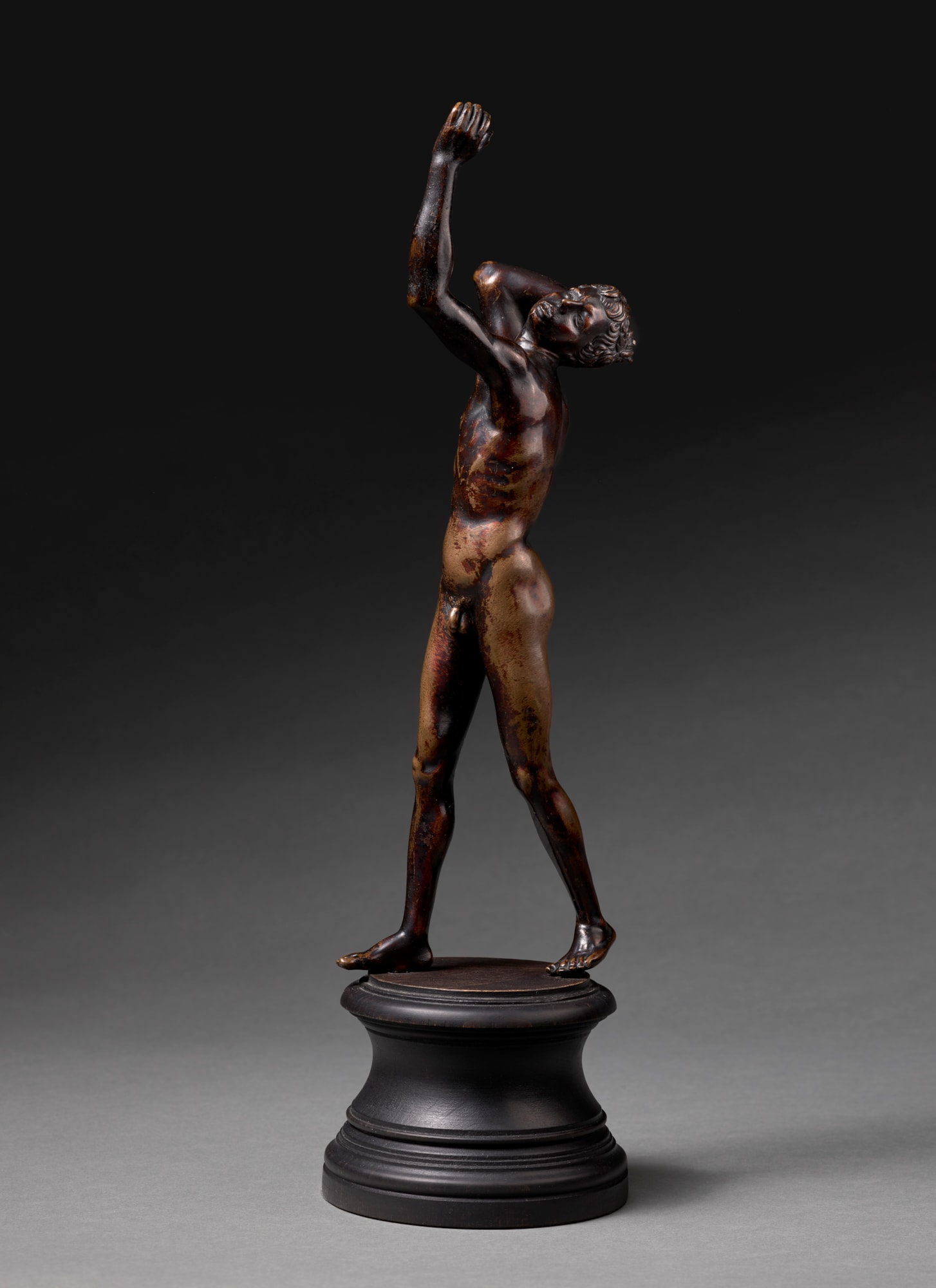
Grieving Youth
Italian
Grieving Youth
Date Second half 16th century
Medium Bronze
Dimension 32.2 x 9 x 12 cm (12⁵/₈ x 3¹/₂ x 4³/₄ inches)
The Dying Niobid is first mentioned in an incunabulum in a famous poem written by the so-called ‘Prospettivo Milanese’, which was printed towards the end of the fifteenth century. The text documents the sculpture’s provenance in the Maffei family’s collection of antiquities in Rome, providing a crucial terminus ante quem for the discovery of the ancient marble. The intricate pose of the sculpture and its heightened expressive quality would have quickly garnered the attention of artists throughout Italy. The influence of the Dying Niobid is evident in various artworks from the Renaissance. A Florentine drawing from around 1500, now housed in the Prado Museum (inv. F.D.149), reflects its impact. It also appears in drawings by the Bolognese painter Amico Aspertini. Aspertini even incorporated it into the figure of a saint in his fresco, The Burial of Valerian and Tiburtius in the Oratorio di Santa Cecilia in Bologna.
Additionally, Raphael included a reference to the Dying Niobid in his Fire in the Borgo fresco in the Stanza dell'Incendio di Borgo in the Vatican — though upright and reversed, as can be seen in the figure hanging down from the wall to the left of the scene. The Venetian painter Vittorio Carpaccio also referenced it in his altarpiece of the Ten Thousand Martyrs, now in the Gallerie dell’Accademia, Venice.
Jeremy Warren, in his recent catalogue on Italian sculpture in the Wallace Collection notes that the latter painter frequently used small bronzes as models or props in his paintings. These statuettes take pride of place in the oil on canvas Saint Augustine in his Study in the Scuola degli Schiavoni, Venice, where such bronzes appear on a shelf to the left of the composition. It may be when Carpaccio painted the Ten Thousand Martyrs in 1515, he drew inspiration from the present composition, rather than the ancient Roman marble in Munich, implying that statuettes of the Grieving Youth were available to view in Venice by the early 16th century.
Apart from the present cast, there are only four known versions of this model: one in the Wallace Collection, London (inv. no. S73); a very crude aftercast in the Herzog Anton-Ulrich Museum, Brunswick (inv. no. Bro 30); another in the Musée du Louvre, Paris (inv. no. TH 82); and a final version formerly in the Adams Collection. A modern cast is preserved in the Staatliche Museen, Berlin (inv. no. K.F.M.V. 94).
Date: Second half 16th century
Medium: Bronze
Dimension: 32.2 x 9 x 12 cm (12⁵/₈ x 3¹/₂ x 4³/₄ inches)
Provenance: Art Market, UK, as of 2018
Private Collection, New York, to 2026
Literature: William von Bode, The Italian Bronze Statuettes of the Renaissance, Vol. I, pl. LXXIX (ill.)
Phyllis Bober and Ruth Rubinstein, Renaissance Artists and Antique Sculpture, London, 1986 [2nd ed., 2010], p.152, n. 109 (ill.)
Jeremy Warren, The Wallace Collection – Catalogue of Italian Sculpture, London, 2016, no. 58, pp. 266-272
Daniel Katz Gallery
Fine Art from Antiquity to the Twentieth Century
Plus d'œuvres d'art de la Galerie
_T638354709335648178.jpg?width=500&height=500&mode=pad&scale=both&qlt=90&format=jpg)