


GEORGE PATTEN
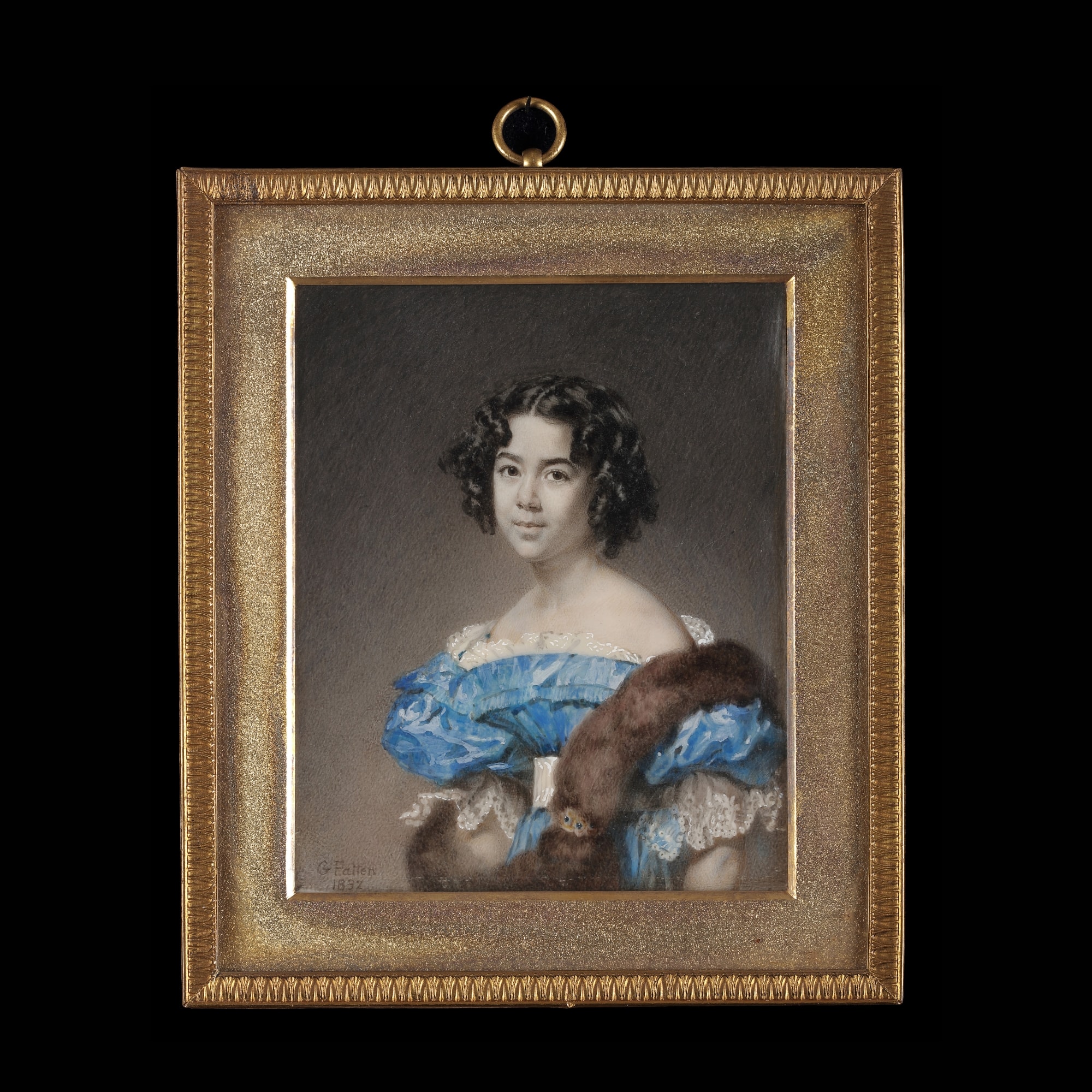
Portrait miniature of a lady in blue silk gown trimmed with white lace, a white sash, and a fur tippet, possibly made of sable, over one shoulder, her hair worn in ringlets
GEORGE PATTEN
Portrait miniature of a lady in blue silk gown trimmed with white lace, a white sash, and a fur tippet, possibly made of sable, over one shoulder, her hair worn in ringlets
The Limner Company : Portrait Miniature
Date 1832
Period Georgian
Origin England
Medium Watercolour on ivory
Dimension 9.8 cm (3⁷/₈ inches)
During the 1830s, a stole or scarf, as the lady in this portrait wears, was known as a ‘tippet’. These popular accessories were defined by their long, narrow shape, and were produced alongside muffs as practical and stylish winter accessories. It is not clear which animal’s fur was used to produce the tippet worn here, though it is possible that it is sable, an expensive and exclusive fur which had to be imported from Northern Asia. Wearing such a fur would not only be useful in the cold, but also fashionable and a symbol of the unknown lady’s wealth.
Almost as dramatic as her tippet are the lady’s ‘leg-of-mutton’ sleeves, trimmed with fine lace, which were also extremely popular in the middle decades of the nineteenth century. Their billowing size emphasised both the curve of the shoulder (when worn with a low neckline as shown here) and a narrow waist, and signalled a move away from the simplicity of the Regency empire-line dress.
Both fashions are satirised in a print published in 1829 [1]. The lady depicted is drowned by a dress with enormous sleeves, a giant hat, and has a long serpent coiled around her neck. The snake holds an apple in its mouth- a reference to original sin. Here, Patten has painted the young lady in these styles to promote her sense of style and taste, rather than to criticise her.
[1] William Heath, ‘The Great Boa Tippet, 1829’, published by Thomas McLean, copy in the British Museum, London, 1893,0612.239.
Date: 1832
Period: Georgian
Origin: England
Medium: Watercolour on ivory
Signature: Signed and dated ‘G. Patten / 1832’ (lower left)
Dimension: 9.8 cm (3⁷/₈ inches)
Provenance: Collection of R.L. Bayne-Powell;
His sale, Sotheby’s, London, 11 October 1994, lot 136, illustrated;
Private Collection, UK.
Literature: D. Foskett, Collecting Miniatures, Suffolk, 1979, p.415, fig. B.

The Limner Company : Portrait Miniature
Potrait miniatures from the 16/17th century, the 18th century and 19th century
More artworks from the Gallery
, wearing blue coat, white waistcoat, and frilled white collar_T639131491024376186.JPG?width=500&height=500&mode=pad&scale=both&qlt=90&format=jpg)
-Portrait oil of a Nobleman, wearing armour, fur-trimmed blue cap, white jabot and powdered wig_T639258409553312706.jpg?width=500&height=500&mode=pad&scale=both&qlt=90&format=jpg)

-Memorial portrait miniature of a Lady in a turban, holding doves in a basket_T639258438160309645.jpg?width=500&height=500&mode=pad&scale=both&qlt=90&format=jpg)
, seated, facing to the right in a coat and waistcoat, with an open book on _T639258448606822430.jpg?width=500&height=500&mode=pad&scale=both&qlt=90&format=jpg)
