


Frank BRANGWYN
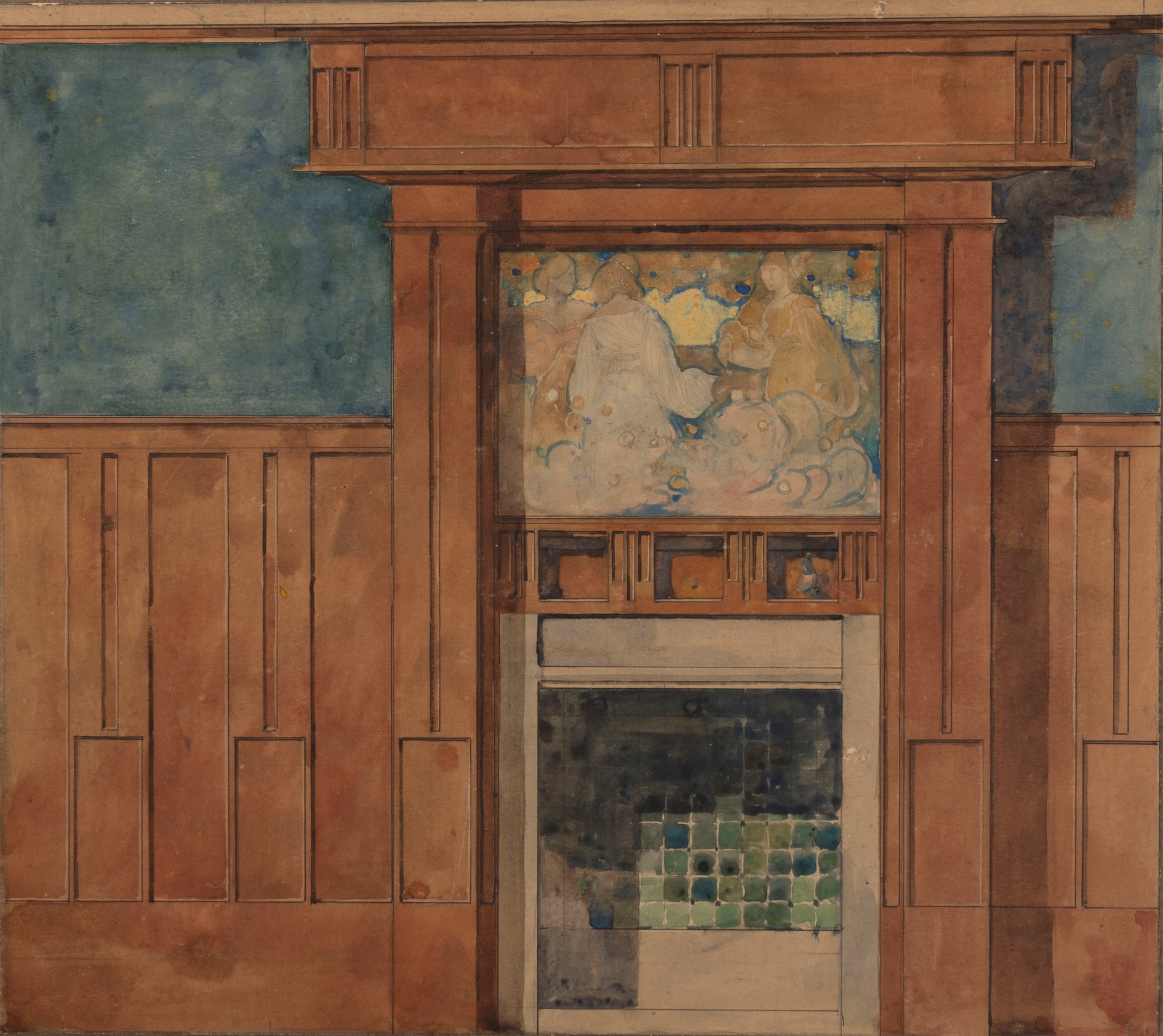
A Design for a Wall with a Fireplace
Frank BRANGWYN
A Design for a Wall with a Fireplace
Datable to around 1900, this large sheet displays many of the characteristics of Brangwyn’s interior design practice, notably the use of wood (in this case apparently cedar) panelling and its division into squares and rectangles, the mottled tiles, and the insertion of a decorative enamel panel above the fireplace. It has been tentatively suggested that this drawing may represent a design for the interior of Temple Lodge, a late Georgian villa in the London borough of Hammersmith where Brangwyn took up residence in 1900, eventually building a large studio next door. A stylistically comparable design by Brangwyn for the wall of a billiard room for the firm of Thurston & Co., datable to c.1902, shared the same provenance from the collection of Edward Peacock.
The present sheet was part of a large and important group of drawings by Brangwyn, for the most part representing his varied work as a designer and decorator, which the artist bequeathed to Edgar Peacock, the son of his longstanding housekeeper in Ditchling in Sussex. These drawings remained completely unknown to collectors and scholars until their dispersal at auction in 2000, following Peacock’s death, and their rediscovery has since served to shed much new light on Brangwyn’s extensive output as a designer.
Provenance: Bequeathed by the artist to Edgar Peacock, the son of his housekeeper Elizabeth (Lizzie) Peacock, Ditchling, Sussex
His posthumous sale, Eastbourne, Edgar Horn, 20 September 2000 [lot unidentified]
Haslam and Whiteway Ltd., London, in 2001.
Literature: Charles Holme, ed., Modern British Domestic Architecture and Decoration [The Studio, Special Summer Number], 1901, illustrated in colour p.43, pl.2 (‘Design for a Fireplace in Cedar Wood, to be decorated with an enamel panel’); Libby Horner, Frank Brangwyn: A Mission to Decorate Life, exhibition catalogue, London, 2006, p.151, no.155 (where dated c.1900).
Exhibition: London, Haslam and Whiteway Ltd., Frank Brangwyn Exhibition, 2001, no.3; London, The Fine Art Society and Liss Fine Art, Frank Brangwyn: A Mission to Decorate Life, 2006, no.155.
Stephen Ongpin Fine Art
Old Master, 19th Century and Modern Drawings, Watercolours and Oil Sketches
More artworks from the Gallery


 Della Sudda, Seated at a Piano_T638203653503780352.jpg?width=500&height=500&mode=pad&scale=both&qlt=90&format=jpg)
