
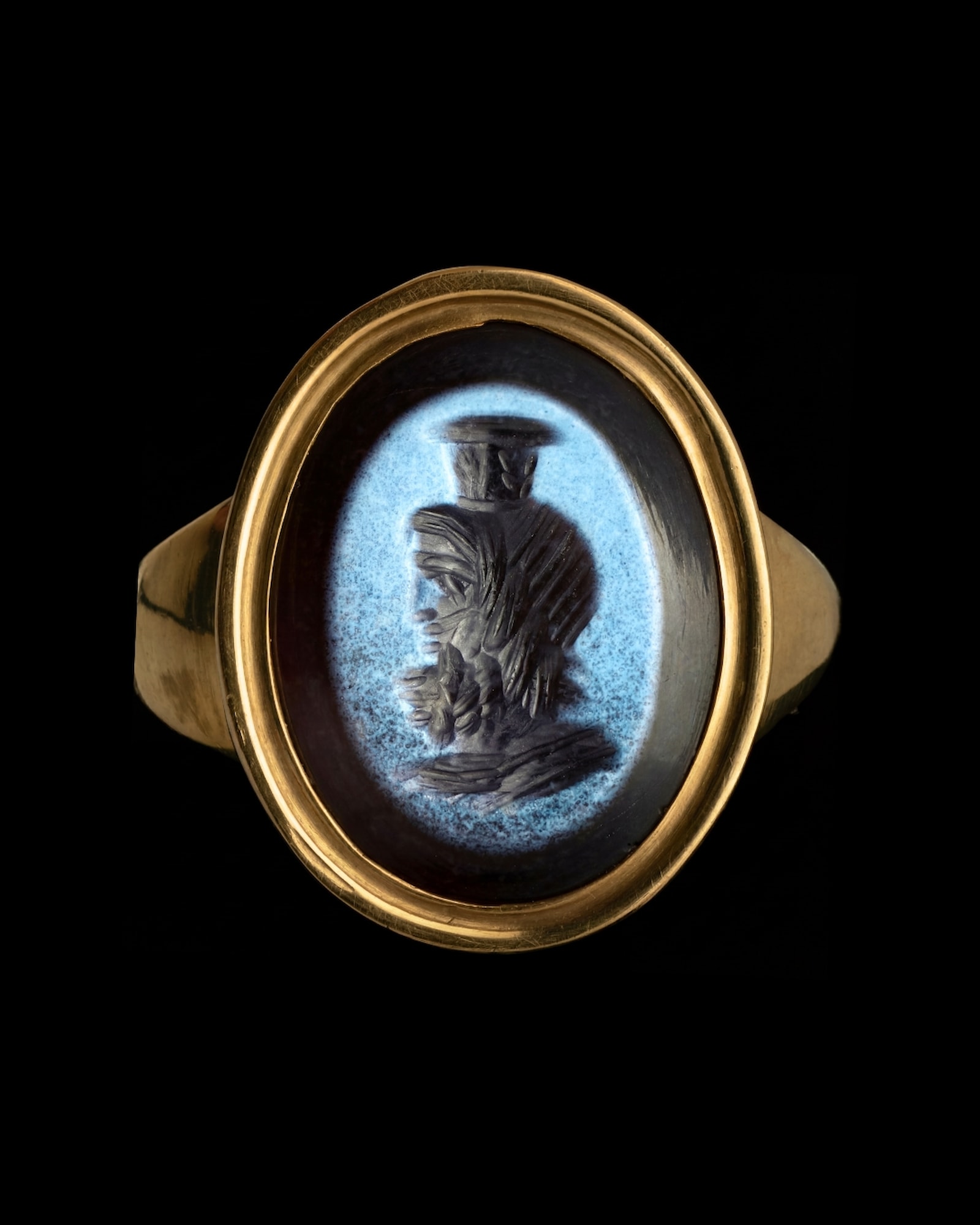
A gold ring with a Roman nicolo intaglio. Jupiter-Serapis.
Marketplace
A gold ring with a Roman nicolo intaglio. Jupiter-Serapis.
A gold ring with a Roman nicolo intaglio. Jupiter-Serapis.
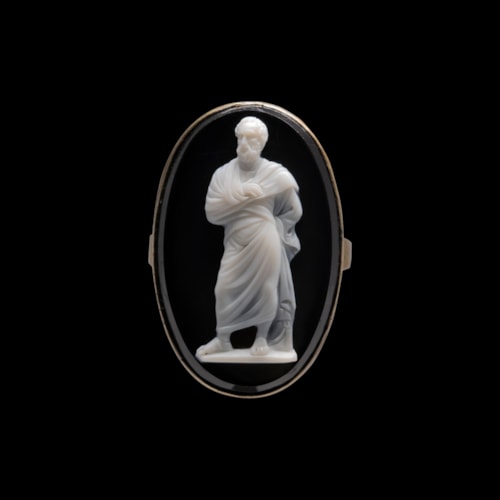
A finely engraved Roman nicolo intaglio of oval form, depicting the bearded bust of Zeus-Serapis in left profile. The god is shown with his canonical attributes: a luxuriant hair falling in heavy locks over the nape, a long curling beard rendered in fine parallel striations, and the kalathos (modius) — the cylindrical grain-measure crown — surmounting his head, the unmistakable mark of his syncretic identity as god of fertility, abundance and the afterlife. The drapery of the himation is visible across the chest, treated in deep parallel cuts that catch the light against the contrasting blue surface of the stone.
The intaglio is carved on nicolo, a particularly prized variety of layered onyx in which a thin upper stratum of pale blue-white agate is left intact around the figure while the engraver cuts through to expose the deep blue-black layer beneath. This two-tone optical effect — the engraved figure appearing dark against a luminous halo of pale blue — was a hallmark of high-quality Imperial Roman glyptic and was especially favoured for theophoric subjects from the 2nd century A.D. onwards. The cutting is fluent and confident, with characteristic rotella and boutroley burin work visible in the hair and beard.
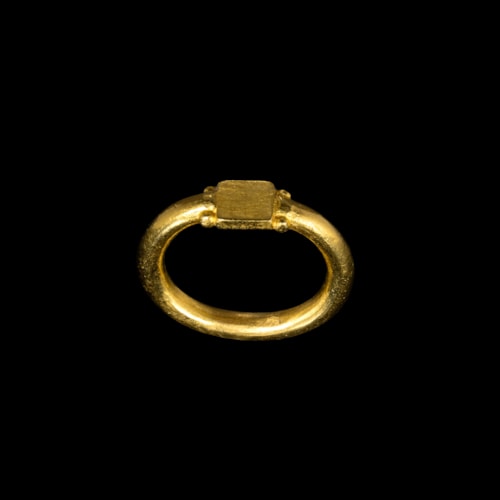
The intaglio is set within a later 18k yellow gold mount of fine craftsmanship, conceived in the 20th century in the manner of the antique signet ring. The oval bezel is framed by a double moulded rim of polished gold, the shoulders tapering gracefully towards a plain D-section shank — a sober mounting that lets the ancient gem speak.
Iconography & cult
Serapis was a syncretic deity formally established under Ptolemy I Soter (305–283 B.C.) to unite the Greek and Egyptian populations of Alexandria around a single tutelary god. His iconography fuses the sovereignty of Zeus (beard, throne, majestic frontal pose), the chthonic authority of Hades (with Cerberus often at his feet), the healing power of Asclepius, the luminous nature of Helios, and — through his root in the Memphite cult of Osor-Apis (the deceased Apis bull assimilated to Osiris) — the Egyptian principles of resurrection and life after death. The kalathos worn on his head, modelled on the corn-measure, signals his role as guarantor of fertility and the cycle of the harvest.
The cult of Serapis spread rapidly from Alexandria across the entire Mediterranean basin, reaching Rome by the late Republic, and became one of the most widely worshipped deities of the Imperial period. The wearing of a Serapis intaglio served as both a personal devotional act and a public statement of cosmopolitan religious sensibility.
Condition
Intaglio in excellent state of preservation, the carving sharp and unworn, the nicolo with its full original two-tone contrast. Mount in very good condition, light surface wear consistent with age and wear.
The intaglio is carved on nicolo, a particularly prized variety of layered onyx in which a thin upper stratum of pale blue-white agate is left intact around the figure while the engraver cuts through to expose the deep blue-black layer beneath. This two-tone optical effect — the engraved figure appearing dark against a luminous halo of pale blue — was a hallmark of high-quality Imperial Roman glyptic and was especially favoured for theophoric subjects from the 2nd century A.D. onwards. The cutting is fluent and confident, with characteristic rotella and boutroley burin work visible in the hair and beard.
The intaglio is set within a later 18k yellow gold mount of fine craftsmanship, conceived in the 20th century in the manner of the antique signet ring. The oval bezel is framed by a double moulded rim of polished gold, the shoulders tapering gracefully towards a plain D-section shank — a sober mounting that lets the ancient gem speak.
Iconography & cult
Serapis was a syncretic deity formally established under Ptolemy I Soter (305–283 B.C.) to unite the Greek and Egyptian populations of Alexandria around a single tutelary god. His iconography fuses the sovereignty of Zeus (beard, throne, majestic frontal pose), the chthonic authority of Hades (with Cerberus often at his feet), the healing power of Asclepius, the luminous nature of Helios, and — through his root in the Memphite cult of Osor-Apis (the deceased Apis bull assimilated to Osiris) — the Egyptian principles of resurrection and life after death. The kalathos worn on his head, modelled on the corn-measure, signals his role as guarantor of fertility and the cycle of the harvest.
The cult of Serapis spread rapidly from Alexandria across the entire Mediterranean basin, reaching Rome by the late Republic, and became one of the most widely worshipped deities of the Imperial period. The wearing of a Serapis intaglio served as both a personal devotional act and a public statement of cosmopolitan religious sensibility.
Condition
Intaglio in excellent state of preservation, the carving sharp and unworn, the nicolo with its full original two-tone contrast. Mount in very good condition, light surface wear consistent with age and wear.
Provenance: European private collection, acquired before 2018.
Découvrez la galerie
Anthea Fine Arts
Antiquities, Classical Sculptures, Glyptics and Jewelry.
Plus d'œuvres d'art de la Galerie