


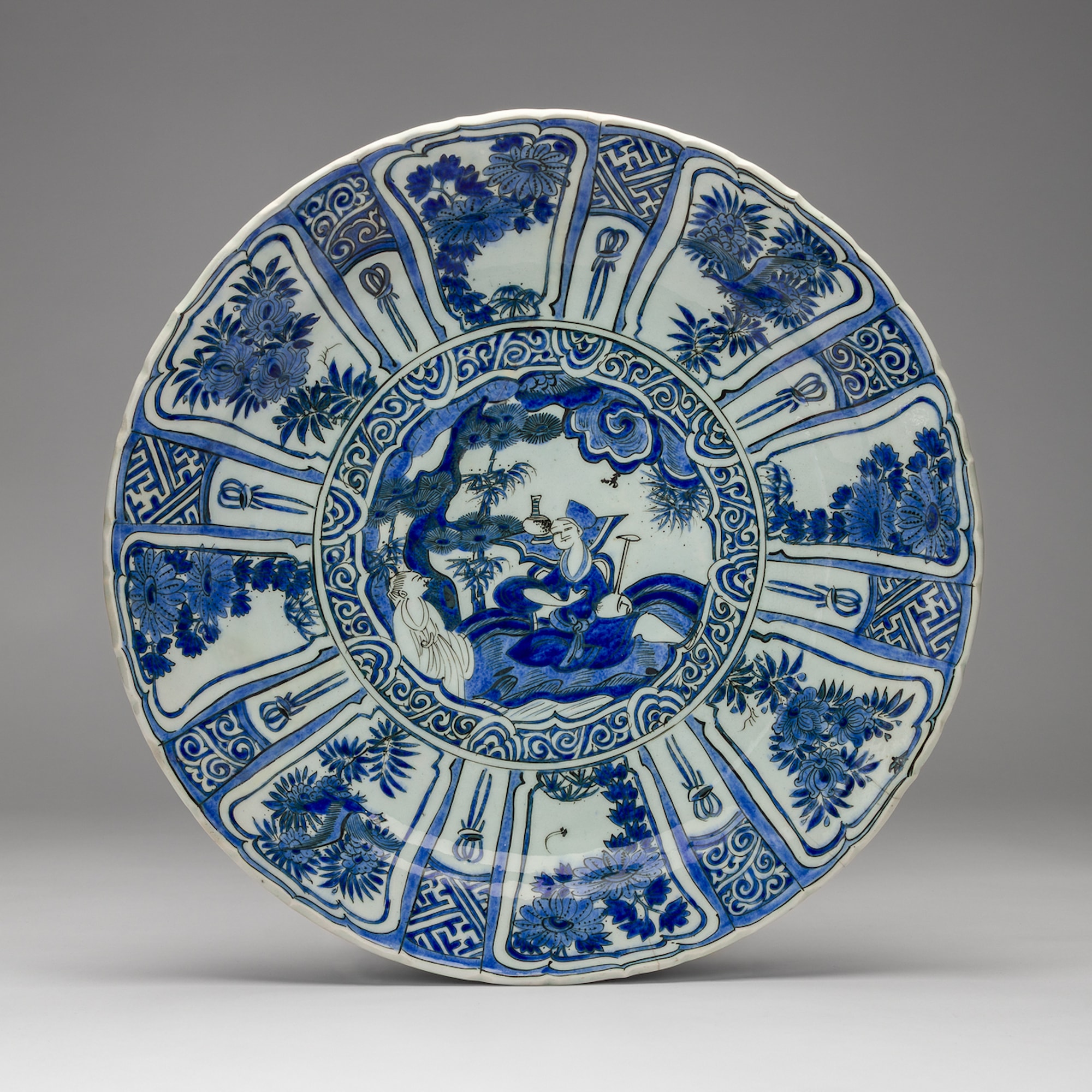
Safavid 'Kraak' Dish
Marketplace
Safavid 'Kraak' Dish
A Safavid charger in the style of a Ming dynasty ‘Kraak’ dish. The rim is decorated with eight lobed panels filled with leafy peach and floral sprays, divided by narrower panels comprising a ribbon below alternate bands of swastika and wave fretwork. An eight-bracket Kraak frame surrounds the central scene of a scholar and attendant. The scholar, who is wearing an upturned hat, sits on one knee with his left leg extended outwards. His left hand holds a long-necked bottle and his right points towards his chest. Behind him is a bottle on a table. His attendant, emerging from the left side of the dish, has a moustache, pointy nose, and hair pulled back. He is depicted only with a fine black outline. The exterior of the dish is decorated with eight panels of foliage and simple ribbon dividers. The foot is plain, but for a black seal or pseudo reign mark.
This dish is related to a series in the Victoria and Albert Museum, London (accession nos 451-1878, 452-1878, and 1088-1876), each dated to ca. 1600–1640. The first of these has near-identical composition to ours, while the others featuring differing, though similar, arrangements of the scholar and moustachioed man. Other dishes of the same type are held in the Hermitage Museum, St. Petersburg,1 and the Royal Ontario Museum (no. 2003.58.1; dated 1640–1650). Although it is tempting to suggest that all of these dishes were all made by the same artist or workshop, the V&A dishes have triangular tassel marks whereas ours has a square seal mark. The similarities probably derive from the use of similar Chinese source material, from which Safavid potters faithfully transposed the designs with only small changes to appeal to the Persian client: a scholar might become a poet and a vase of flowers might become a long-necked bottle.2
n.b. accession nos are clickable links.
[1] Golombek, Lisa, Robert B. Mason, Patricia Proctor, and Eileen Reilly. Persian Pottery in the First Global Age : The Sixteenth and Seventeenth Centuries. Leiden: Brill, 2013, p. 153, fig. 3.44.
[2] Crowe, Yolande. Persia and China : Safavid Blue and White Ceramics in the Victoria & Albert Museum, 1501-1738. Geneva: La Borie, 2002, pp. 63–64, cats 27–29.
Découvrez la galerie

Amir Mohtashemi Ltd.
Indian,Islamic and Cross-Cultural Works of Art
Plus d'œuvres d'art de la Galerie
_T638839372011235433.jpg?width=500&height=500&mode=pad&scale=both&qlt=90&format=jpg)

_T638568988938247202.jpg?width=500&height=500&mode=pad&scale=both&qlt=90&format=jpg)

